What is art journaling?
It’s a question that appears on countless blogs, in workshops, and beneath social media posts. But here is how I see it — how it lives and unfolds within Kunstkammer Berlin.
I began this practice in the 1980s, long before it had a name.
Back then, it was something improvised — intuitive, layered, and private. A way of working things out through images, textures, scraps, and time. Since then, art journaling has become an industry, often packaged with ready-made formulas. But for me, it remains something else: an open-ended, tactile encounter with the page. A way to find your voice — not to copy someone else’s steps.
This love of the page — and of the book itself — runs deep.
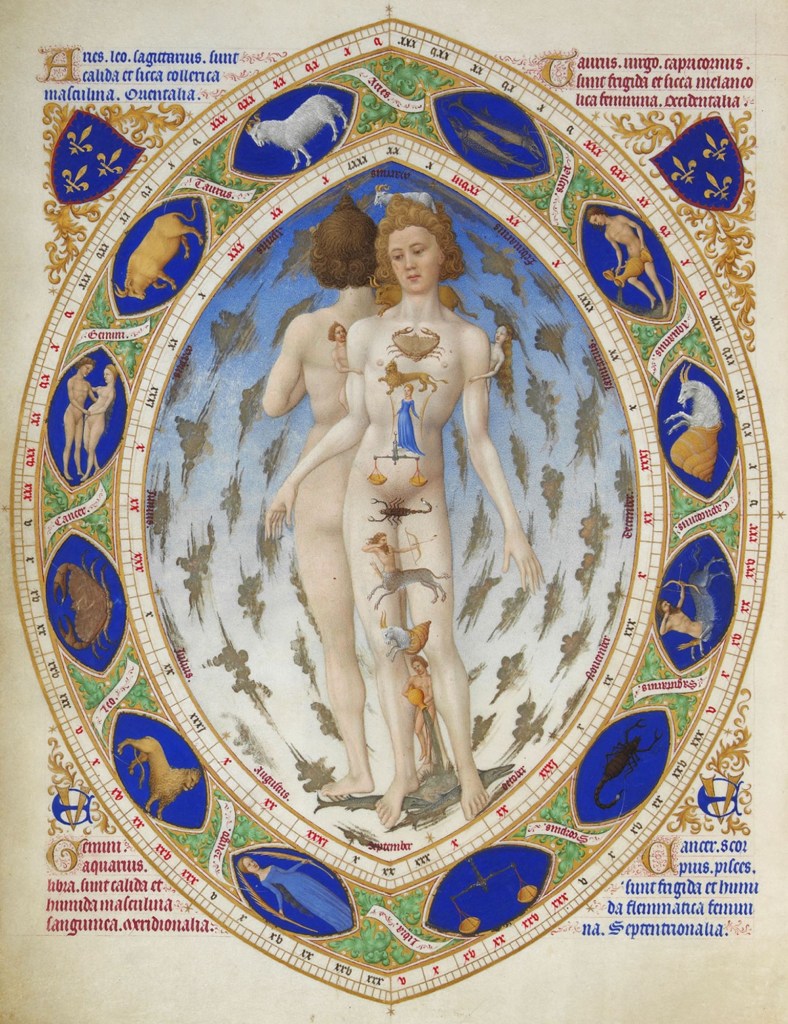
Detail from Les Très Riches Heures du Duc de Berry, c.1411–1416. The Anatomical Zodiac Man.
A different kind of page — but one that echoes forward into the present.
I grew up surrounded by antique books and rare manuscripts, raised by a father who was an antiquarian book dealer. These were rare objects, sometimes centuries old, and always full of mystery. I grew up with a feeling for books: the weight in the hand, the act of turning a page, the quiet presence of something made to last.
That love never left. It lives on in the way I work — and in the way I teach.
And sometimes I wonder if, one day, our art journals may become future antiquarian collector’s items too.
As manuscripts of our time,
marked by the materials we used,
and the world we lived in.
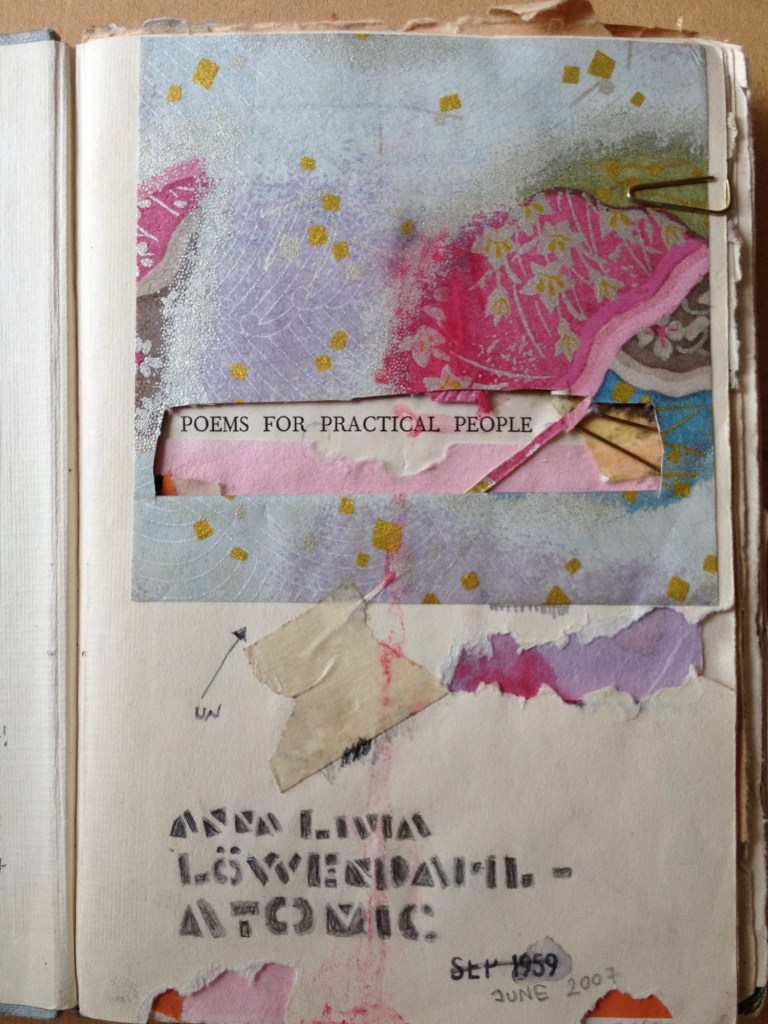
Created by altering a vintage book originally titled Poems for Practical People.
Some of the original words remain — anchoring the new in the old.
Art journaling is a visual, intuitive, and tactile way of working.
It begins with curiosity — the desire to explore, to try, to combine fragments of meaning (or nonsense) without knowing exactly where they’ll lead.
I prefer to create my art journals by altering old books, not a store-bought one. A found book is altered, transformed, and prepared — its pages given texture, layers, and materials before I even begin. And that changes everything. Instead of intimidating blank pages, it becomes a book full of tactile surfaces ready for experimentation, where I can embrace the freedom to make mistakes and discover what emerges.
You enter not with a plan, but with a willingness to begin.
Some pages may remain raw and unrefined, while others become layered with collage, paint, fabric, stenciling, mark making, and symbols.
There are pages that arrive quickly, and others that unfold slowly over time.
Some hold questions; others carry letters, numbers, words, traces of thought, fleeting reflections, cut-up poetry and asemic writing that weaves its own meaning through marks and gestures.
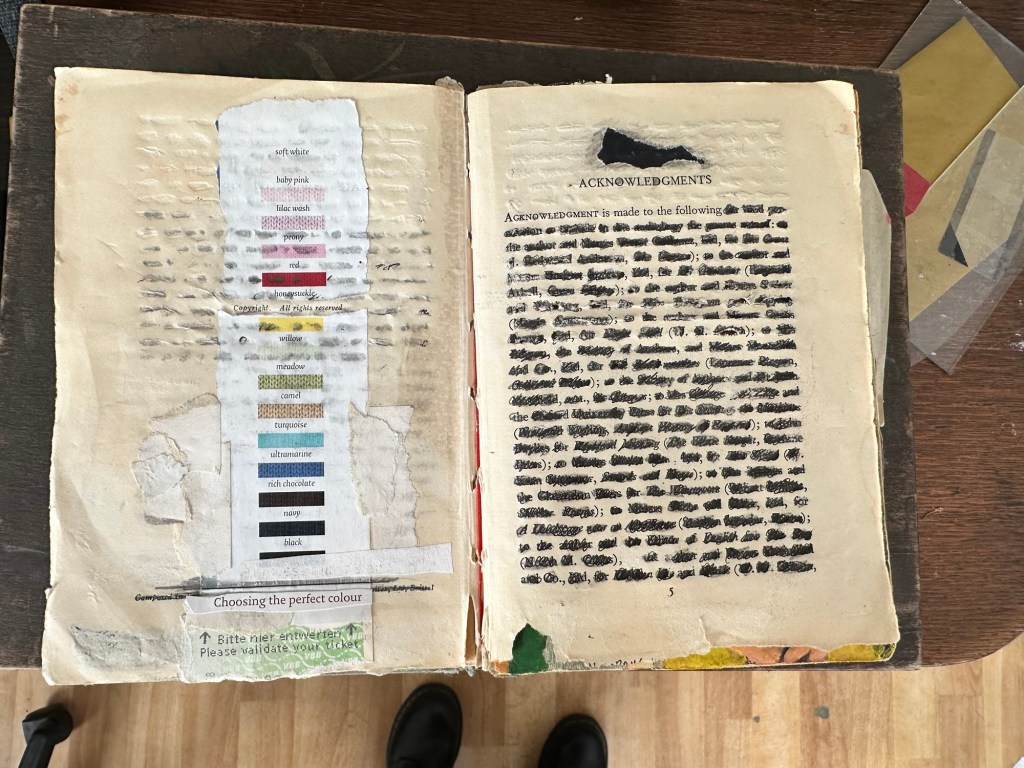
Another page from the same art journal, 2007.
The heading remains: Acknowledgments. But the names are gone — scribbled out, disappeared, made unreadable. A gesture of erasure that echoes through many of my conceptual works: themes of absence, authorship, memory, and the forgotten.
A page might be a secret hidden beneath layers of paint.
Or a loud rebellion.
Or simply a surface to work into, and away from.
Nothing needs to be finished. Nothing is wrong.
There’s texture in every choice: the soft resistance as gesso dries under your fingertips. The whisper of tissue paper as it settles into wet medium. The satisfying scratch of a pencil against a textured surface. The scent of acrylic paint mingling with old book pages—part chemistry, part alchemy. These sensations become as much a part of the practice as the visual elements themselves.
What emerges is not a fixed form, but a personal Kunstkammer —
a cabinet of gestures, textures, and quiet revelations.
Each page a drawer.
Each spread a space to return to.
You follow your hands.
You follow the material.
You follow the impulse to see what happens if…
You notice the subtle pleasure of materials meeting: how ink blooms and spreads when it touches a damp surface; the gentle tearing sound as you separate found paper; the weight of a book that’s slowly expanding with collected moments and materials; the quiet rhythm of your breath as you lose yourself in process.

A book in transformation — thick with time, fragments, and the quiet weight of process.
Art journaling is a way of being with materials — and with yourself.
It’s not about outcome, but process.
Not about doing it well, but about doing it with care and attention.
And here is the paradox:
Art journaling isn’t about the outcome — and yet, that’s exactly why the outcome so often feels right.
It carries a kind of perfection born from its messiness.
From the freedom, the flaws, the lack of control.
From not trying to make it good.
It becomes honest.
Unpolished.
Whole.
At Kunstkammer Berlin, the practice unfolds through learning: how to alter a book, how to prepare pages, how to follow materials rather than plans. These practical techniques become the foundation for personal experimentation.
Berlin becomes part of the process — a place to gather from, to be surprised by, to respond to.
The journal becomes a companion for both the outer and inner world.
There are no rules.
But there is rhythm.
And there is trust — in the layers, in the process, in the beautiful mistake.
You don’t need to know what you’re doing.
You don’t need to know what you’re doing.
You just need to begin.
And when you leave us,
you’ll carry the thread — and know how to keep stitching it forward.
What you make may one day be read — as record, as relic, as resonance.
To join us for current art journaling courses and workshops in Berlin, click here
Text © Anna Livia Löwendahl-Atomic, 2025.
 KUNSTKAMMER BERLIN
Leave a comment